
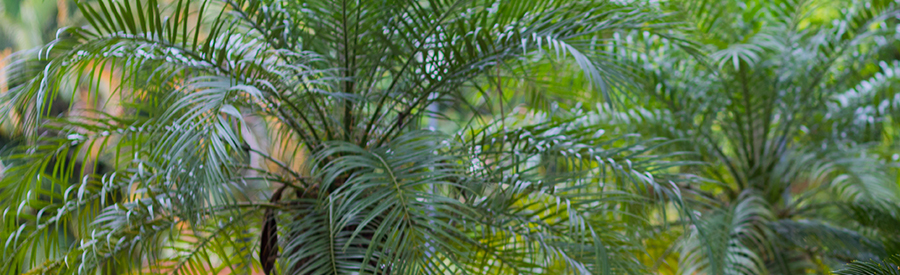
Nothing says Florida quite like a palm tree. In Sarasota and throughout Southwest Florida, palms are an important part of the landscape, adding tropical character, texture and year-round greenery. With so many varieties available, however, choosing the right palm depends on how much space you have and the look you want to create.
Here are five of the most popular palms for Southwest Florida landscapes and some of the reasons homeowners continue to choose them.
1. Foxtail Palm
Mature Height: Approximately 25–30 feet
The Foxtail Palm (Wodyetia bifurcata) has become one of the most recognizable landscape palms in Florida. Its name comes from its full, fluffy fronds, which resemble a fox’s tail and create a lush tropical appearance.
Foxtails are popular because they have a clean, attractive trunk, relatively fast growth and a beautiful symmetrical canopy. They work especially well as specimen palms near entrances, around pools or planted in rows along driveways. Their mature size is impressive without becoming overwhelming for many residential properties.
UF/IFAS notes that Foxtail Palms can reach about 30 feet tall and grow well in full sun while also tolerating some shade.
2. Sylvester Palm
Mature Height: Approximately 40–50 feet
The Sylvester Palm (Phoenix sylvestris), also called the Wild Date Palm, is a favorite when homeowners want a substantial palm with a more formal appearance. Its large crown of blue-green, feather-like fronds creates a dramatic focal point in the landscape.
Sylvesters are frequently planted in front yards, near driveway entrances and in larger landscape beds. Their thick, textured trunks can also be trimmed to create the familiar diamond-shaped pattern seen in many professionally landscaped properties.
Although relatively slow growing, a mature Sylvester Palm can eventually approach 50 feet in height, with individual fronds reaching around 10 feet long.
3. Areca Palm
Mature Height: Approximately 20–30 feet
Need privacy as well as a tropical look? The Areca Palm (Dypsis lutescens), also known as the Yellow Butterfly Palm, is one of the most useful choices for Southwest Florida homes.
Unlike single-trunk palms, Arecas grow as clusters of slender stems topped by arching, feathery fronds. This dense growth makes them especially popular for creating natural privacy screens around lanais, pools, property lines and patios.
Arecas grow relatively quickly and can reach approximately 20 to 30 feet tall, although another UF/IFAS reference notes that some specimens may reach about 35 feet. Their combination of height and fullness makes them an excellent alternative to a traditional hedge when you want something distinctly tropical.
4. Pygmy Date Palm
Mature Height: Approximately 10–12 feet
Not every Florida landscape needs a towering palm. The Pygmy Date Palm (Phoenix roebelenii) remains extremely popular because its smaller size makes it easy to incorporate around patios, pools, entrances and smaller homes.
Its graceful, arching fronds provide the classic feather-palm appearance without taking over the landscape. Although naturally a single-trunk palm, Pygmy Dates are commonly planted in groups of two, three or more to create the attractive multi-trunk appearance frequently seen in Florida landscapes.
UF/IFAS describes the Pygmy Date as one of Florida’s most popular small landscape palms and notes that it generally reaches about 12 feet tall with a 6- to 8-foot spread.
5. Sabal or Cabbage Palm
Mature Height: Approximately 40–60 feet
For a palm that truly belongs in Florida, it’s hard to beat the Sabal Palm (Sabal palmetto). Also known as the Cabbage Palm, it is Florida’s state tree and is native to the state.
One of the biggest reasons for its popularity is adaptability. Established Sabal Palms handle Florida’s heat, sandy soils, periods of drought and coastal conditions exceptionally well. UF/IFAS lists the palm as having both high drought tolerance and high salt tolerance, making it especially well suited to Sarasota County and other coastal areas.
Mature Sabal Palms commonly reach approximately 40 to 60 feet tall, with UF/IFAS references listing maximum heights around 50 to 60 feet. Their tall trunks and distinctive fan-shaped foliage create the unmistakable natural Florida look.
Which Palm Is Right for Your Landscape?
The best palm depends on what you want it to accomplish. Foxtail Palms provide a polished tropical focal point, while Sylvester Palms make a bold statement in larger landscapes. Areca Palms are excellent for creating privacy, Pygmy Date Palms fit beautifully into smaller spaces, and the native Sabal Palm provides an authentic Florida appearance along with excellent adaptability.
Before choosing a palm, consider its mature height and width—not simply its size at the time of planting. Giving a palm enough room to reach its natural size can make a significant difference in both its appearance and long-term success.